
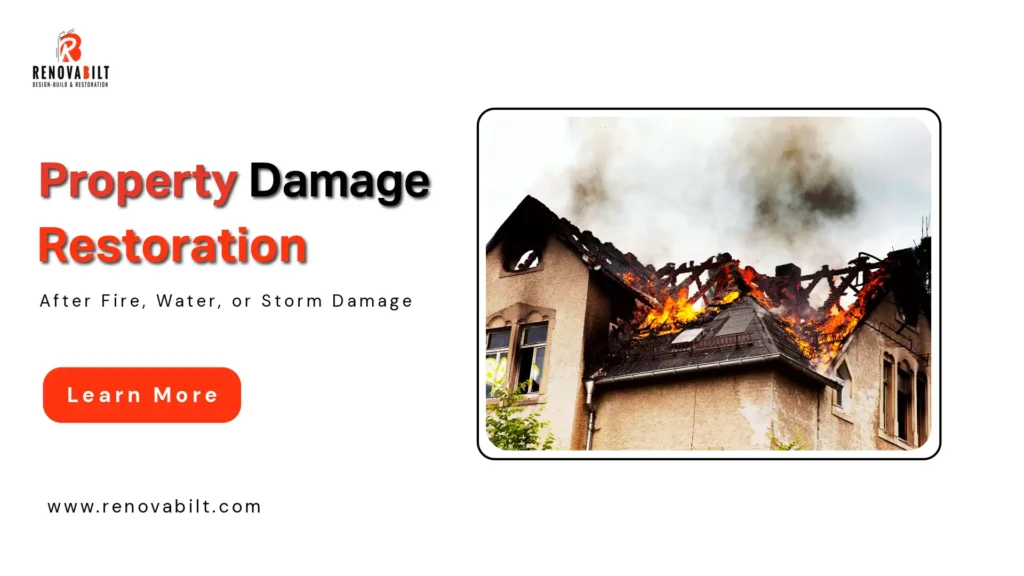
Experiencing property damage is one of the most stressful events a homeowner or business owner can face. Whether it’s the aftermath of a grease fire, a burst pipe in the upstairs bathroom, or a devastating coastal storm, the feeling of helplessness is often the first thing to set in. However, the path from a damaged structure back to a safe, beautiful home is a precise, scientific process.
At RenovaBilt, we believe that clarity is the first step toward recovery. With over 10 years of hands-on experience and our IICRC-certified expertise, we’ve seen how proper restoration saves properties that seemed beyond repair. This guide breaks down exactly how the restoration process works for fire, water, and storm damage, backed by the data and technical steps required to do the job right.
Part 1: The Fire Restoration Process Step by Step
Fire damage is uniquely complex because it involves three distinct types of damage: the fire itself (heat), smoke and soot (chemical), and water (from firefighting efforts). According to the National Fire Protection Association (NFPA), local fire departments responded to an estimated 1.38 million fires in the U.S. in recent years, resulting in billions of dollars in property damage.
Step 1: Emergency Contact and 24/7 Response
The clock starts the moment the fire is out. Acidic soot begins to etch into surfaces immediately. RenovaBilt provides true 24/7 availability because we know that a delay of even six hours can mean the difference between cleaning a marble countertop and having to replace it.
Step 2: Assessment and Inspection
What does a fire restoration company do first? We perform a site safety survey. We check for structural integrity, identify the “smoke path,” and categorize the type of soot.
- Dry Smoke: Fast-burning, high-temp fires.
- Wet Smoke: Low-heat, smoldering fires with pungent odors and smeary residue.
- Protein Residue: Invisible but smells horrific; common in kitchen fires.
Step 3: Board-Up and Tarping
Fires often break windows and compromise roofs. To prevent looting and weather damage, we secure the perimeter. This is a critical liability step for insurance claims.
Step 4: Water Removal and Drying
It sounds counterintuitive, but fire and water restoration go hand-in-hand. Firefighters use hundreds of gallons of water. If we don’t dry the property first, mold will begin to grow within 24 to 48 hours. We use industrial-grade dehumidifiers and air movers to stabilize the environment.
Step 5: Soot and Smoke Removal
This is where professional “humanized” restoration beats DIY. We use specialized techniques like:
- HEPA Vacuuming: To capture fine soot particles without spreading them.
- Dry Chem Sponges: To lift soot from porous surfaces.
- Ultrasonic Cleaning: For delicate items and electronics.
Step 6: Cleaning and Sanitizing
We clean every inch of the affected area. This includes HVAC duct cleaning, as smoke particles linger in the ventilation system and recirculate every time the AC kicks on.
Step 7: Rebuilding and Restoration
The final stage of fire damage restoration involves minor repairs like painting and drywall or major structural overhauls.
Part 2: Your Professional Fire Restoration Checklist
If you are currently facing a loss, use this checklist to ensure no steps are missed during the recovery phase:
| Phase | Action Item | Priority |
| Immediate | Contact Insurance & Professional Restorer | Critical |
| Security | Board up the windows and tarp the roof | High |
| Inventory | Document damaged items with photos/video | High |
| Mitigation | Professional water extraction and drying | Critical |
| Cleaning | Soot removal from walls, ceilings, and ducts | Medium |
| Deodorization | Thermal fogging or ozone treatment | Medium |
| Final | Structural repairs and final walkthrough | Completion |
Part 3: The Science of Water Damage Restoration
Water damage is the most common form of property loss in the U.S. Statistics from the insurance industry suggest that 1 in 50 insured homes has a water damage claim every year.
Categorizing the Water
Water damage restoration isn’t just about “getting things dry.” It’s about managing biohazards.
- Category 1 (Clean Water): From a broken supply line or sink overflow. Understanding common causes of plumbing leaks can help homeowners identify potential problems before they result in more serious issues.
- Category 2 (Gray Water): Contains significant contamination (dishwasher or washing machine discharge).
- Category 3 (Black Water): Highly contaminated (sewage, rising river water). This requires specialized PPE and antimicrobial treatments.
The Drying Goal
We don’t just feel the carpet to see if it’s dry. We use moisture meters and thermal imaging cameras to find water hidden behind drywall and under hardwood floors. We establish a “drying goal” based on the moisture content of unaffected materials in your home to ensure the structure is returned to its “dry standard.”
Part 4: Storm Damage and Rebuilding
Storms combine the worst of all worlds: high winds, impact damage (falling trees), and massive water intrusion.
The Statistics of Storm Recovery
- Wind damage accounts for roughly 25% to 30% of all property insurance claims.
- Flash flooding is the most frequent and costly natural disaster in the United States.
The RenovaBilt Approach to Storms
When a storm hits, the local infrastructure is often overwhelmed. Because we maintain true 24/7 readiness, we are able to deploy teams for immediate roof stabilization. Storm restoration involves:
- Debris Removal: Clearing trees and shattered glass.
- Structural Shoring: Supporting compromised walls or ceilings.
- Moisture Management: Since storms often involve “Category 3” water from the ground, we prioritize deep sanitization to prevent long-term health risks.
Part 5: Why IICRC Certification Matters
You might wonder, “Why can’t a general contractor do this?”
Restoration is a specialized field. The IICRC (Institute of Inspection Cleaning and Restoration Certification) sets the global standards. An IICRC-certified firm like RenovaBilt follows a scientific “Standard of Care.”
Using a non-certified company for fire and water restoration often leads to “secondary damage”—this is when the initial water is cleared, but hidden moisture leads to a massive mold outbreak three months later. Our 10+ years of experience ensure we catch those hidden variables the first time.
Part 6: Navigating the Insurance Maze
A significant part of what a restoration company does involves documentation. To get your claim paid, you need:
- Moisture Maps: Proof that the house was wet and is now dry.
- Scope of Work: A detailed list of every action taken.
- Inventory Logs: A list of “Non-Salvable” vs. “Salvable” items.
We work directly with your adjusters to provide the data-loaded reports they require to process your claim quickly.
Conclusion: Trusting the Experts
Property damage is a disruption of your life, but it doesn’t have to be the end of your home’s story. At RenovaBilt, we combine over a decade of hands-on grit with the latest restoration technology to bring your property back to its pre-loss condition.
Whether you are looking for a fire restoration guide or need a team that understands the step-by-step nuances of rebuilding a fire-damaged home, we are here. Our 24/7 availability isn’t just a slogan; it’s our commitment to being there when your world feels like it’s upside down. Do you have property damage right now? Don’t wait for the damage to set in. Callthe pros at RenovaBilt today.
Frequently Asked Questions
Water drying usually takes 3 to 5 days. Fire restoration can take anywhere from two weeks to several months, depending on the structural damage and the extent of the smoke infiltration.
For fire damage, it is rarely advised due to “Particulate Matter” (PM2.5) in the air, which can cause respiratory issues. For water damage, it depends on the “Category.” Category 3 losses usually require relocation for health reasons.
Yes—but only if treated professionally. We use Hydroxyl Generators or Ozone Machines that break down the odor molecules at a chemical level rather than just masking them with scents.