
Flooding is one of the most disorienting things a homeowner can face. One moment, your house is your sanctuary. Next, you’re standing in inches or feet of murky water, wondering where to even begin.
One of the hardest decisions you’ll make in those first hours is figuring out what’s worth saving and what needs to go. It’s emotional. It’s exhausting. And if you make the wrong call, it can also be dangerous.
After a flood, hard and non-porous items, such as metal, glass, ceramic, solid wood, and stone, can usually be saved with proper cleaning and drying. Soft, porous materials like mattresses, upholstered furniture, carpet padding, drywall, and insulation almost always need to go. All food and medications that touched floodwater must be discarded. Speed matters: mold begins growing within 24–48 hours.
This guide breaks it down clearly, room by room, category by category, so you can make smarter decisions faster.
Why This Decision Matters More Than You Think
Floodwater isn’t just water. It’s a mixture of sewage, chemicals, bacteria, and debris. Even if the water looks relatively clean, it almost certainly isn’t. Items that absorb this water become breeding grounds for mold, mildew, and harmful pathogens — sometimes within 24 to 48 hours.
Keeping the wrong things doesn’t just risk your health. It slows down your recovery and can compromise the safety of your entire home.
That’s why professional teams that handle flood damage reconstruction in Denver and Aurora don’t just dry things out; they triage. They assess what’s salvageable and what poses ongoing risk, so your home is truly safe when it’s restored, not just surface-dry.
Items That Can Often Be Saved
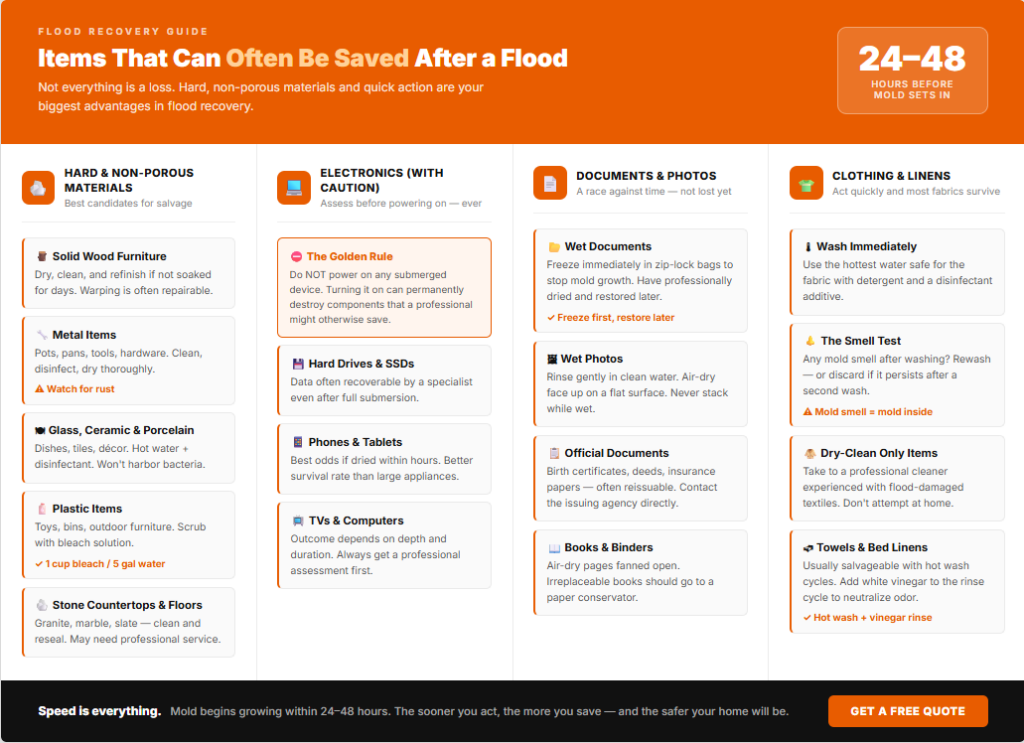
Let’s start with the good news. Not everything is a loss.
Hard, Non-Porous Materials
These are your best candidates for salvage because they don’t absorb water the way soft materials do.
- Solid wood furniture — If it hasn’t been soaking for days, solid wood can often be dried out, cleaned, and refinished. Warping may occur, but it’s frequently repairable.
- Metal items — Pots, pans, appliances with metal bodies, tools, and hardware. Clean, disinfect, and dry thoroughly. Watch for rust.
- Glass, ceramic, and porcelain — Dishes, decorative items, tiles. Wash with hot water and disinfectant. These surfaces don’t harbor bacteria the way porous materials do.
- Plastic items — Children’s toys, storage bins, outdoor furniture. Scrub and disinfect with a bleach solution (1 cup bleach per 5 gallons of water).
- Stone countertops and flooring — Granite, marble, and slate can be cleaned and sealed. They may need professional cleaning depending on the contamination level.
Electronics (With Caution)
Electronics are tricky. Never power on a device that has been submerged until it has been professionally assessed. However, many electronics can be salvaged if they’re dried out quickly and correctly.
- Hard drives and SSDs can sometimes be recovered by a data recovery specialist.
- Smartphones and tablets have better odds than larger appliances if dried within hours.
- TVs, computers, and home theater equipment depend heavily on submersion depth and duration.
The general rule: do not turn it on. Let a professional assess it first.
Documents and Photos
Paper items are a race against time, but they’re not automatically lost.
- Freeze wet documents in zip-lock bags to stop mold growth, then have them professionally dried and restored later.
- Wet photos should be rinsed gently in clean water, air-dried face up, and never stacked while wet.
- Important documents — birth certificates, deeds, insurance papers — can often be restored or reissued. Contact the issuing agency.
Clothing and Linens
Machine-washable fabrics can frequently be saved if treated quickly.
- Wash in the hottest water safe for the fabric with detergent and a disinfectant additive.
- If there’s any mold smell after washing, rewash or consider discarding.
- Dry-clean-only items should go to a professional cleaner experienced with flood-damaged textiles.
Items That Almost Always Have to Go
This is the harder part. But being honest here protects your health and your home’s long-term integrity.
Drywall and Insulation
Drywall is porous. Once it absorbs contaminated floodwater, it becomes a mold factory behind your walls. The general standard in professional reconstruction after flood damage is to cut out and replace drywall that was submerged, typically at least 12 inches above the waterline to account for wicking.
Insulation is even less forgiving. It absorbs moisture and holds it, creating ideal conditions for mold and bacteria. It must be removed and replaced entirely.
Carpeting and Padding
Carpet padding is almost never salvageable. It traps water, dries unevenly, and grows mold quickly. Carpeting itself can sometimes be cleaned and dried if the flood was clean water and you act within hours, but if floodwater from outside was involved, professional guidance strongly recommends replacement.
Hardwood flooring is case-by-case. If it’s cupped but not buckled, professional drying with industrial equipment can sometimes restore it. Laminate flooring, however, almost always needs replacement once submerged.
Mattresses, Pillows, and Upholstered Furniture
Any item with internal padding or foam that has absorbed floodwater should be discarded. This includes:
- Mattresses and box springs
- Sofas and upholstered chairs
- Pillows and cushions
- Stuffed animals and soft toys
These items cannot be adequately cleaned on the inside. Even if the surface looks fine and smells okay at first, mold and bacteria will grow in the interior layers. It’s simply not worth the health risk, especially if children or elderly individuals live in the home.
Particle Board and MDF Furniture
Unlike solid wood, furniture made from particle board or medium-density fiberboard (MDF) swells, warps, and disintegrates when wet. It cannot be dried out and restored. Bookcases, flat-pack furniture, and most affordable cabinetry fall into this category.
Food and Medications
This one is non-negotiable.
- Discard all food that has come into contact with floodwater — including canned goods with dents or damaged seals, and any food stored below the waterline.
- Discard all medications that were submerged. Flood contamination can degrade medications and make them unsafe or ineffective.
When in doubt, throw it out. Food poisoning and medication failure are serious risks that aren’t worth taking.
Cosmetics and Personal Care Products
Flooded cosmetics, skin care products, and personal hygiene items should all be discarded. Containers may look intact, but contaminated water can seep in through caps and seals.
A Room-by-Room Quick Reference
Kitchen
- Save: Metal cookware, glass/ceramic dishes, appliances (once cleared by a professional), solid wood cabinets (if lightly damaged)
- Discard: All food, particle board cabinets, flooring (typically), countertop items that touched floodwater
Living Room
- Save: Solid wood furniture, metal frames, decorative glass and ceramics, electronics (don’t power on — assess first)
- Discard: Upholstered furniture, rugs and carpet, particle board shelving, drywall
Bedrooms
- Save: Solid wood bed frames, metal furniture, clothing (washed promptly), hard-case items
- Discard: Mattresses, pillows, drywall, carpet
Bathroom
- Save: Porcelain fixtures, tile, glass, metal fixtures
- Discard: Medications, cosmetics, any porous materials
Basement
- Save: Metal tools, sealed containers, and solid items you can disinfect
- Discard: Drywall, insulation, carpet, cardboard boxes, particle board storage units
The 48-Hour Rule: Why Speed Is Everything
Mold can begin growing in as little as 24 to 48 hours after flooding. Every hour you wait makes salvage harder and health risks greater. Here’s what to do immediately:
- Document everything — photograph and video all damage before touching anything. This is critical for insurance claims.
- Stop the water source — don’t begin cleanup until the flooding has stopped.
- Contact your insurance company — the sooner you file, the sooner the process starts.
- Begin ventilation — open windows and doors, set up fans if safe to do so.
- Call a flood restoration professional — industrial drying equipment makes a real difference in what can be saved.
What Professionals Do That DIY Can’t
There are a lot of homeowners who can handle themselves in the early stages. But there are things that genuinely require professional expertise.
Industrial-grade dehumidifiers and air movers remove moisture from walls, subfloors, and structural cavities in ways household fans simply can’t. Moisture meters identify hidden water damage inside walls before mold takes hold. Antimicrobial treatments address contamination at a level that household cleaners don’t reach.
Teams experienced in flood damage reconstruction in Denver and Aurora understand local building codes, work directly with insurance companies, and know how to restore your home to pre-flood standards — not just cosmetically, but structurally and safely.
A Note on Sentimental Items
Not everything has a replacement value. For irreplaceable items, family photos, heirlooms, and handmade pieces, don’t give up before consulting a specialist. Document and paper conservators, professional photo restorers, and antique conservators can work genuine miracles with items that seem like total losses.
Pack these items carefully, store them in a cool, dry environment, and reach out to a specialist before making any decisions.
Get Expert Help — You Don’t Have to Figure This Out Alone
Flood recovery is overwhelming. Between the emotional weight, the insurance paperwork, and the sheer physical labor, it’s easy to make decisions in the heat of the moment that you’ll later regret.
Working with a trusted restoration team means you get an honest, experienced assessment of your home — what’s safe to keep, what needs to go, and what the path forward looks like for full structural recovery.
Get a Free Quote. If your home has experienced flood damage and you’re not sure where to start, our team is here to help. We’ll assess the damage, walk you through your options, and give you a clear, no-obligation quote for restoration and reconstruction.
📞 Call now for a free quote — and take the first step toward getting your home back.
The faster you act after a flood, the more you can save. But protecting your health and your home’s long-term safety always comes first.