
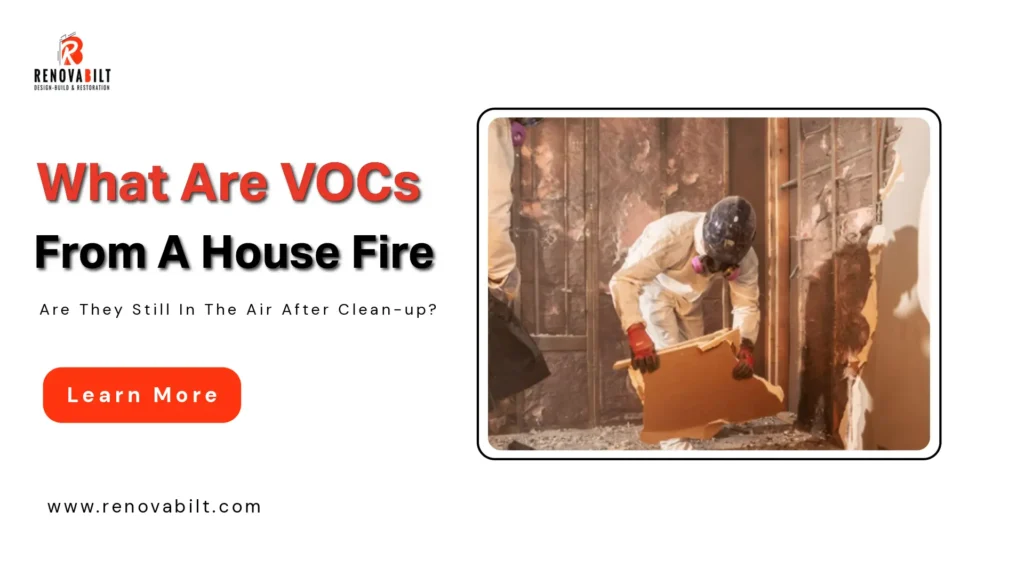
A house fire leaves behind more than charred walls and smoke stains. One of the most serious. and most overlooked – threats after a fire are something you can’t see at all: volatile organic compounds, or VOCs. These invisible chemicals linger in the air, settle into surfaces, and can silently affect your health long after the flames are out.
If you’ve recently experienced a fire, or if you’re in the middle of cleanup, understanding VOCs isn’t just helpful, it’s essential.
What Are VOCs, Exactly?
VOC stands for volatile organic compounds. These are carbon-based chemicals that easily evaporate into the air at room temperature. You’ve probably encountered them in everyday products, paints, cleaning supplies, new carpet, or even air fresheners. They’re common. But when a fire burns through a home, VOC exposure jumps to a completely different level.
During a fire, VOCs are released in massive amounts as building materials, furniture, plastics, textiles, and household chemicals are combusted. The problem is that not all burning is clean or complete. Fires smolder. Materials partially combust. And that incomplete burning creates a toxic soup of chemical byproducts, many of which are VOCs.
Where Do Fire-Related VOCs Come From?
The specific VOCs released during a house fire depend largely on what burned. Here’s a breakdown of the most common sources:
Building materials Drywall, wood framing, insulation, and adhesives, all release VOCs when burned. Pressed wood products like particleboard and MDF are especially problematic because they contain formaldehyde-based binders that volatilize rapidly in heat.
Furniture and upholstery Sofas, mattresses, and carpet, contain foam, synthetic fabrics, and flame retardants. When these combust, they release compounds like benzene, toluene, styrene, and polycyclic aromatic hydrocarbons (PAHs), a class of chemicals known to be harmful with prolonged exposure.
Plastics and electronics Burning plastic is one of the most chemically complex events in a residential fire. PVC pipes, electrical wiring insulation, appliances, and plastic fixtures release hydrogen chloride, dioxins, and chlorinated VOCs. These are among the most toxic compounds generated in any fire scenario.
Household cleaners, paints, and stored chemicals Many homes have garages, storage closets, or utility rooms with products like solvents, pesticides, aerosol cans, and automotive fluids. When these are exposed to heat or flame, the chemicals inside are released directly — sometimes explosively — adding a concentrated dose of toxic VOCs to the mix.
Cooking materials and food Even fires that start in the kitchen can combust oils, spices, and food packaging, releasing acrolein — a sharp, irritating compound also found in cigarette smoke.
Common VOCs Found After a House Fire
Here are some of the most frequently detected VOCs in post-fire environments, along with what they come from:
- Benzene — released from burning plastics, rubber, and petroleum-based products; a known human carcinogen
- Formaldehyde — from burning wood composites, insulation, and upholstery; causes irritation to the eyes, nose, and throat
- Acrolein — from burning fats, oils, and synthetic materials; even small concentrations can irritate airways significantly
- Toluene and xylene — from burning paints, varnishes, and adhesives- affect the central nervous system at high exposures
- Styrene — from burning foam insulation and plastics; potential nervous system effects
- Naphthalene — from burning wood and coal; can damage red blood cells
- Hydrogen cyanide — from burning wool, silk, polyurethane, and nylon; highly toxic even at low levels
It’s worth noting that exposure to any one of these compounds at low levels isn’t necessarily an emergency. The concern after a house fire is the combination — the cumulative, ongoing exposure to many chemicals at once, over days or weeks.
Are VOCs Still Present After Cleanup?
This is the question most homeowners don’t think to ask — and it’s one of the most important ones.
The short answer: Yes, often they are.
Standard fire cleanup — sweeping debris, wiping surfaces, painting over smoke stains — does not eliminate VOCs. In many cases, it can actually trap them. Here’s why:
VOCs Absorb Into Porous Materials
Smoke and VOCs don’t just float in the air. They penetrate deeply into drywall, wood, insulation, carpet padding, clothing, and even concrete. This process is called off-gassing, and it can continue for months — or longer — after the fire is out.
When temperatures rise inside a cleaned home (like on a hot summer day), those absorbed compounds can re-volatilize back into the air. This is why some homeowners notice that “smoke smell” returns weeks later. What they’re smelling isn’t always just odor — it can be a sign that VOCs are still being released.
Surface Cleaning Doesn’t Reach the Source
Professional-grade cleaning removes visible soot and surface residue. But VOC molecules are microscopic. They’ve bonded with materials at a molecular level. Wiping a countertop or repainting a wall doesn’t address what’s embedded in the substrate beneath.
HVAC Systems Become Reservoirs
Your heating and cooling system pulls air through the entire home. During a fire, smoke-laden air passes through ductwork, depositing soot and VOC residue onto duct walls, coils, and filters. After cleanup, running the HVAC can redistribute those compounds throughout every room — including rooms that weren’t directly affected by the fire.
Odor Masking Is Not Remediation
Some restoration approaches involve deodorizing sprays, ozone treatments, or sealing products that cover up smoke odor without addressing the chemical source. These methods may temporarily reduce what you smell, but they don’t remove VOC contamination from the environment.
Health Effects of VOC Exposure After a Fire
Prolonged or repeated exposure to post-fire VOCs can affect health in several ways, depending on the individual and the level of exposure:
- Respiratory irritation — coughing, shortness of breath, tightening in the chest
- Eye, nose, and throat irritation — common with formaldehyde and acrolein
- Headaches and dizziness — associated with benzene, toluene, and carbon monoxide residue
- Fatigue and cognitive effects — some VOCs affect the central nervous system with sustained exposure
- Worsening of existing conditions — people with asthma, COPD, allergies, or immune conditions are more vulnerable
Children, the elderly, and anyone with a pre-existing respiratory or cardiovascular condition face greater risk from post-fire VOC exposure.
What Proper VOC Remediation Actually Looks Like
Effective post-fire VOC removal requires a systematic, professional approach — not just a thorough cleaning. Here’s what real remediation involves:
Air quality testing first Before any work begins, the air should be tested for VOC levels. Industrial hygienists or certified indoor air quality specialists use equipment that identifies specific compounds and their concentrations. You can’t address what you haven’t measured.
Structural material assessment Materials that have absorbed heavy VOC contamination — porous drywall, soft wood, carpet, insulation — may need to be removed and replaced rather than cleaned. Attempting to seal or clean heavily contaminated materials often doesn’t work long-term.
HEPA filtration and air scrubbing Commercial-grade air scrubbers with HEPA and activated carbon filtration pull VOCs from the air as part of the remediation process. Activated carbon is especially effective at adsorbing gaseous VOCs.
HVAC cleaning and replacement Ductwork, air handlers, and coils need professional cleaning, and filters absolutely must be replaced. In severe cases, sections of ductwork may need to be replaced entirely.
Thermal fogging or encapsulation (done right) When used correctly and as part of a comprehensive plan — not as a standalone fix — encapsulants can lock in residual compounds in materials that can’t be removed. This is a final step, not a first one.
Post-remediation verification testing After work is complete, the air should be re-tested to confirm that VOC levels have returned to safe, acceptable ranges before anyone moves back in.
Why This Matters for Denver and Aurora Homeowners
Colorado’s climate adds a layer of complexity to fire remediation. Homes here are tightly sealed for much of the year to manage heating and cooling costs. That’s great for energy efficiency — but it means VOCs that enter a home have fewer opportunities to naturally dissipate. Tight building envelopes can trap contamination indoors far more effectively than homes in milder, more naturally ventilated climates.
Our team, providing Fire and Smoke Damage Restoration in Denver and Aurora, understands the specific challenges local homeowners face — from the construction types common in the metro area to the seasonal conditions that affect how long VOC contamination can persist indoors.
Don’t Assume “Clean” Means “Safe”
That’s the biggest takeaway here. A home can look clean, smell mostly normal, and still have VOC levels that aren’t safe for long-term occupancy, especially for children and anyone with health sensitivities.
If your home has experienced a fire, even a contained or small one, the air quality deserves serious attention. Standard cleaning services aren’t equipped to test for or remediate VOCs. That requires trained professionals with the right equipment, a systematic process, and a commitment to getting it right, not just getting it done.
Our Emergency Fire and Smoke Damage Restoration services are built around exactly that standard. We don’t cut corners, we don’t mask problems, and we don’t call a job finished until the air quality data says it is.
Get a Free Quote
You deserve to know what’s actually in your air, and you deserve a team that will be honest with you about it.
Get a Free Quote → Our fire and smoke damage specialists are available around the clock. We’ll assess your situation, answer your questions, and walk you through exactly what safe, thorough remediation looks like for your home.
No pressure. No guesswork. Just clear answers and real solutions.