
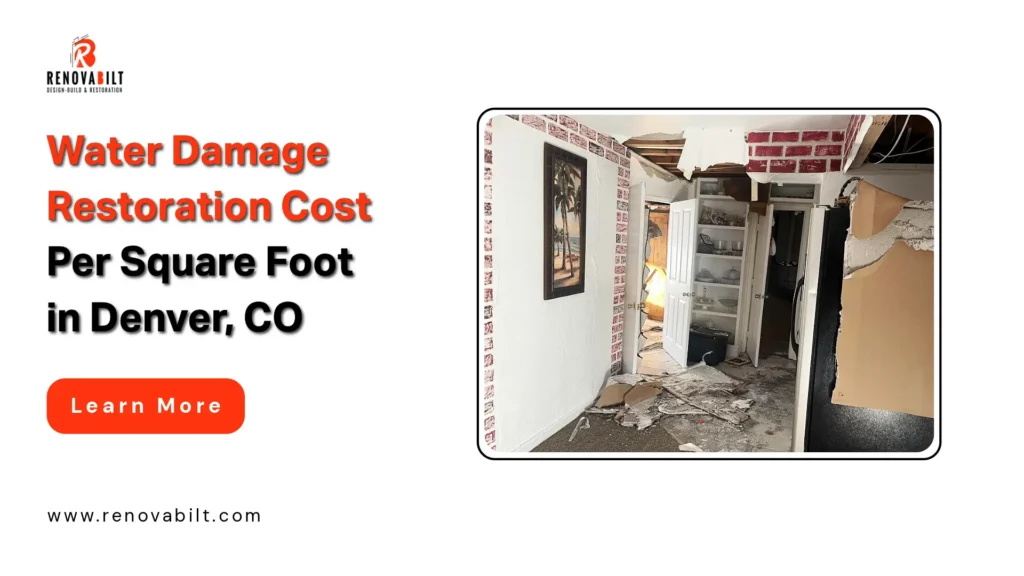
Water damage may begin with as small a problem as a leaking supply line and eventually lead to damage to the flooring, drywall, insulation, or the structural materials. When you are handling a water damage situation in
Denver, a common first question is about the cost of the restoration. In 2026, the data on costs published in Denver shows that the repair of water damage amounts to about $2 to $5.25 per square foot for a great many projects. Angi gives an average cost for Denver projects of around $2,732, with reported costs ranging from $1,251 to $4,647.
Although these figures can be used when preparing a budget, they are not set rates. The real cost will vary according to the water source, the level of contamination, the types of materials affected, the size of the area damaged, the drying requirements, and whether reconstruction is necessary.
Water damage restoration cost per sq ft in Denver
A general reference range for Denver is:
| Project type | Approximate cost |
| Minor water damage | $2–$4 per sq. ft. |
| Moderate water damage | $3.75–$5.25 per sq. ft. |
| Severe or contaminated damage | $5.25+ per sq. ft. |
| Mitigation | About $3–$7.50 per sq. ft. nationally |
| Reconstruction | Can exceed $20 per sq. ft., depending on repairs |
The Denver figures come from Angi’s 2026 local cost data. National restoration estimates are broader because labor rates, property conditions, and project scopes vary by location.
Example Cost by Affected Area
Using the $2–$5.25 per-square-foot Denver range:
| Affected area | At $2/sq. ft. | At $5.25/sq. ft. |
| 250 sq. ft. | $500 | $1,312.50 |
| 500 sq. ft. | $1,000 | $2,625 |
| 750 sq. ft. | $1,500 | $3,937.50 |
| 1,000 sq. ft. | $2,000 | $5,250 |
| 1,500 sq. ft. | $3,000 | $7,875 |
| 2,000 sq. ft. | $4,000 | $10,500 |
These are mathematical examples based on published rates, not quotes. A project can cost more when it involves contaminated water, extensive demolition, mold remediation, or reconstruction.
What Determines Water Damage Restoration Cost?
Square footage is only one factor. A restoration estimate can change significantly based on the following.
Type of Water
Water damage is classified into three categories based on contamination.
Category 1 generally comes from a sanitary source, such as a broken water supply line.
Category 2 contains a greater level of contamination and can come from sources such as certain appliance leaks or overflows.
Category 3 is heavily contaminated and can involve sewage or other contaminated water sources.
Higher contamination levels require additional safety measures, cleaning, removal, and disposal procedures. National cost estimates place Category 1 restoration around $3.50 per square foot, Category 2 around $5.25, and Category 3 around $7.50, although actual costs vary.
Size of the Damaged Area
A larger affected area generally requires more labor, extraction, drying equipment, monitoring, and material removal.
However, square footage does not tell the entire story. Water trapped underneath flooring or inside a wall can require more work than visible standing water over a larger open area.
How Far the Water Has Traveled
Water can move beneath flooring, behind baseboards, into drywall, through insulation, under cabinets, and into wall or ceiling cavities.
Professional restoration companies use moisture meters and other inspection equipment to locate moisture that may not be visible.
Time Since the Water Damage Occurred
Time can affect both the amount of damage and the materials that can be saved.
The EPA recommends drying wet or damp materials within 24 to 48 hours when possible to help prevent mold growth.
A leak addressed quickly may require extraction and drying. A leak that remains unnoticed for several days may result in damaged drywall, flooring, insulation, or other materials that need to be removed and replaced.
Materials Affected
Different building materials respond differently to water.
Restoration may involve:
- Carpet and padding
- Hardwood flooring
- Engineered flooring
- Drywall
- Insulation
- Subflooring
- Cabinets
- Baseboards
- Framing
- Ceiling materials
The EPA provides different cleanup considerations based on the material and extent of water exposure.
Mold Growth
Persistent moisture can create conditions that support mold growth.
The EPA recommends controlling the moisture source and drying wet materials within 24–48 hours when possible. If mold has already developed, additional remediation may be required beyond standard water extraction and drying.
Structural Damage
Water can reach structural components such as framing, subfloors, and ceiling assemblies.
When structural repairs are required, the project moves beyond basic water mitigation. Additional construction work can include framing, drywall, flooring, electrical work, painting, and other repairs.
What Is Included in Water Damage Restoration?
The exact scope varies by project, but professional water damage restoration can include:
- Property inspection
- Moisture detection
- Water extraction
- Standing-water removal
- Air movers
- Dehumidifiers
- Moisture monitoring
- Removal of damaged materials
- Cleaning and sanitizing
- Odor control
- Structural drying
- Documentation for insurance claims
The ANSI/IICRC S500 Standard for Professional Water Damage Restoration covers inspection, evaluation, drying technology, equipment, safety, structural restoration, contents restoration, and documentation.
Water Mitigation vs. Water Damage Repair
The following terms refer to the various stages involved in the restoration process.
The aim of water mitigation is to prevent further damage, and it usually involves carrying out water extraction, drying the affected areas, monitoring the moisture levels, and getting rid of any materials that cannot be saved.
Water damage repair or reconstruction involves getting the property back to its original state after the water has been taken away, and this process can cover drywall, flooring, cabinets, framing, painting, electrical work, and other types of construction.
It is important to keep this distinction in mind when comparing different estimates since a quote that covers the extraction and drying of water won’t include the cost of rebuilding the damaged room.
RenovaBilt Construction and Restoration offers water damage restoration services, which may involve water extraction, drying, cleaning, and repair.
Common Causes of Water Damage in Denver Homes
Denver homeowners can experience water damage from several sources, including:
- Frozen or burst pipes
- Water heater failures
- Washing machine leaks
- Dishwasher leaks
- Refrigerator supply lines
- Toilet overflows
- Plumbing failures
- Roof leaks
- Basement water intrusion
- Sewer backups
- Storm-related water intrusion
Frozen pipes are a particular concern during cold weather. Denver Water recommends insulating vulnerable pipes and knowing where the home’s main water shutoff valve is located.
How the Water Damage Restoration Process Works
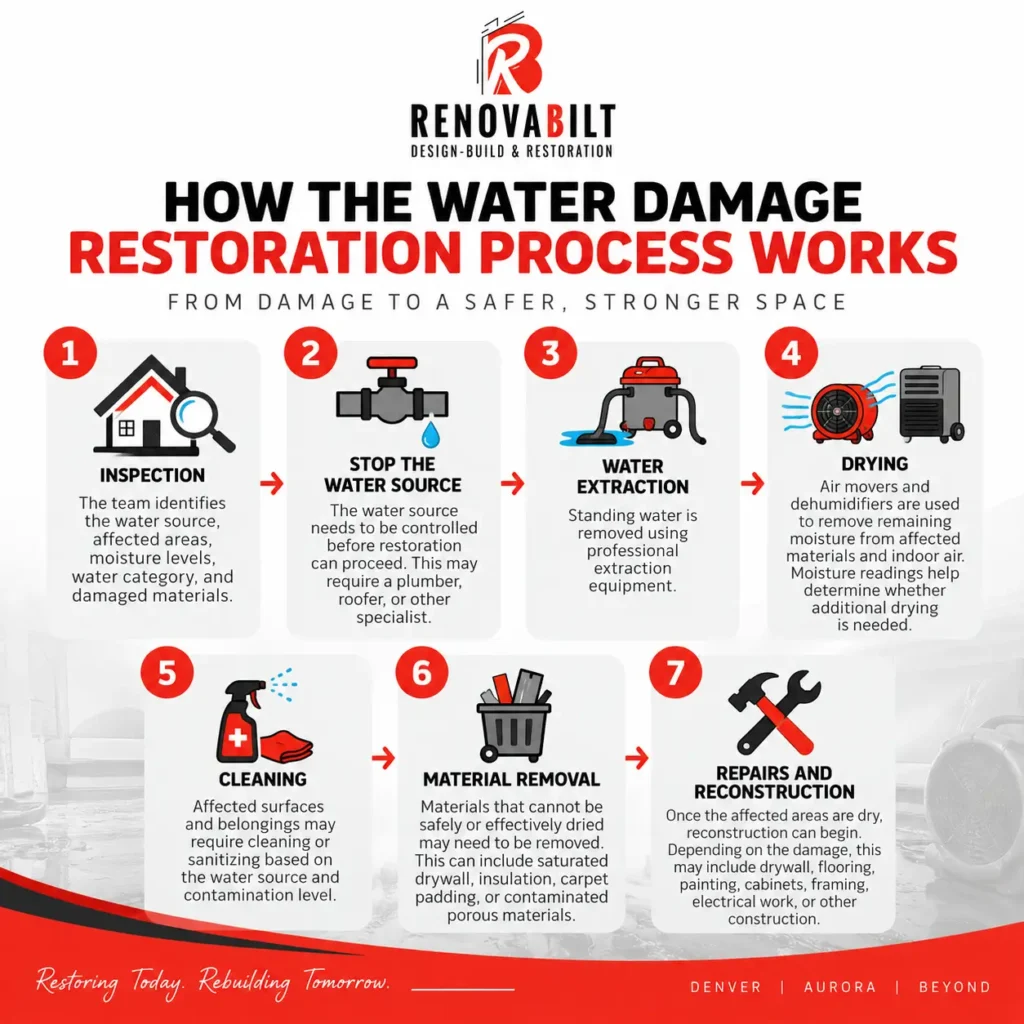
1. Inspection
The restoration team identifies the water source, affected areas, moisture levels, water category, and damaged materials.
2. Stop the Water Source
The water source needs to be controlled before restoration can proceed. Depending on the problem, this may require a plumber, roofer, or other specialist.
3. Water Extraction
Standing water is removed using professional extraction equipment.
4. Drying
Air movers and dehumidifiers are used to remove remaining moisture from affected materials and indoor air.
Moisture readings help determine whether additional drying is needed.
5. Cleaning
Affected surfaces and belongings may require cleaning or sanitizing based on the water source and contamination level.
6. Material Removal
Materials that cannot be safely or effectively dried may need to be removed.
This can include saturated drywall, insulation, carpet padding, or contaminated porous materials.
7. Repairs and Reconstruction
Once the affected areas are dry, reconstruction can begin. Depending on the damage, this may include drywall, flooring, painting, cabinets, framing, electrical work, or other construction.
Does Homeowners Insurance Cover Water Damage?
The extent of the insurance coverage will vary according to the type of policy and the reason for the damage.
A plumbing failure that is both sudden and accidental should be handled in a different way from that involving gradual water seepage, maintenance issues, or certain kinds of flooding.
If the property has suffered serious water damage, take photographs and videos of it if it is safe to do so. Also make sure to keep records of the restoration cost estimates, invoices, the damaged possessions, and all your communications with the insurance company.
RenovaBilt says that it cooperates with insurance companies and helps property owners with the claims process.
Your insurance company decides what your policy covers.
How to Compare Water Damage Restoration Estimates
Don’t compare contractors based only on the total price.
Ask:
How many square feet are included?
Make sure the estimate identifies the actual affected area.
Is this mitigation or complete restoration?
Find out whether extraction, drying, demolition, repairs, and reconstruction are included.
What type of water is involved?
Category 1, 2, and 3 water can require different procedures.
What equipment will be used?
Ask whether the drying plan includes air movers, dehumidifiers, moisture meters, and monitoring.
What materials will be removed?
The estimate should identify materials that are expected to be removed and why.
Are mold remediation and reconstruction included?
These may be separate from the initial water mitigation work.
Are plumbing or roofing repairs included?
The company performing restoration may not be responsible for fixing the original source of the water.
How to Reduce Additional Water Damage
If you discover water damage:
- Stop the water source if it is safe to do so.
- Stay away from electrical hazards and standing water where electrical equipment may be involved.
- Remove or protect undamaged belongings when it is safe.
- Document the damage with photos and videos.
- Start drying the area quickly.
- Arrange professional assessment when water has entered walls, flooring, ceilings, or other hidden areas.
The EPA’s 24–48-hour drying guidance makes a quick response especially relevant when building materials have become wet.
When Should You Call a Water Damage Restoration Company?
Professional help is appropriate when:
- A pipe has burst
- A basement has flooded
- Water has entered walls or ceilings
- Flooring or subflooring is saturated
- Sewage is involved
- The water source is unknown
- Hidden moisture is suspected
- Mold is present
- Structural materials may be damaged
- You need documentation for an insurance claim
- You cannot completely dry the affected area yourself
For contaminated water, professional restoration is especially important because cleanup and safety requirements differ from those for clean-water leaks.
Frequently Asked Questions
What is the average water damage restoration cost per square foot in Denver?
Published 2026, Denver cost data from Angi places water damage repair at approximately $2 to $5.25 per square foot. Angi reports an average Denver project cost of about $2,732.
How much does it cost to restore 1,000 square feet of water damage in Denver?
Using the published Denver range of $2–$5.25 per square foot, 1,000 square feet would produce an illustrative calculation of $2,000 to $5,250. The actual estimate may be higher or lower depending on the water category, materials, drying requirements, and repairs.
Does water damage restoration include reconstruction?
Not necessarily. Water mitigation typically focuses on extraction, drying, cleaning, and preventing further damage. Reconstruction may include drywall, flooring, cabinets, framing, painting, and other repairs.
How quickly should water damage be dried?
The EPA recommends drying wet or damp materials within 24 to 48 hours, when possible, to help prevent mold growth.
Can water-damaged drywall be saved?
It depends on the extent and duration of water exposure, the water category, and whether the drywall can be adequately dried. Severely saturated or contaminated drywall may need to be removed.
Does homeowners insurance pay for water damage restoration?
Coverage depends on the policy and cause of loss. Sudden and accidental water damage may be covered in some circumstances, while gradual leaks and certain types of flooding may be excluded.
Does RenovaBilt provide water damage restoration in Denver?
Yes. RenovaBilt Construction and Restoration provides water damage restoration services in Denver and Aurora, including water extraction, drying, cleanup, and repairs.
Final Takeaway
For Denver homeowners, $2 to $5.25 per square foot is a useful 2026 reference range for many water damage restoration projects. However, the square-foot price alone does not tell you what the project will cost.
The final price depends on the source and category of water, affected square footage, moisture penetration, materials, drying requirements, contamination, demolition, and reconstruction.
If you have water damage in Denver or Aurora, RenovaBilt Construction and Restoration can assess the affected property and determine the restoration work required.
Water damage should be addressed quickly. The sooner the source is controlled and wet materials are properly dried, the better the chance of limiting additional damage.
Sources
- IICRC — S500 Standard for Professional Water Damage Restoration
- EPA — A Brief Guide to Mold, Moisture and Your Home
- EPA — Water Damage Cleanup and Mold Prevention
- Denver Water — Preventing and Thawing Frozen Water Pipes
- RenovaBilt — Water Damage Restoration Services
Cost figures are market estimates and are not a quote from RenovaBilt. Actual restoration costs depend on the conditions and scope of work at each property.