
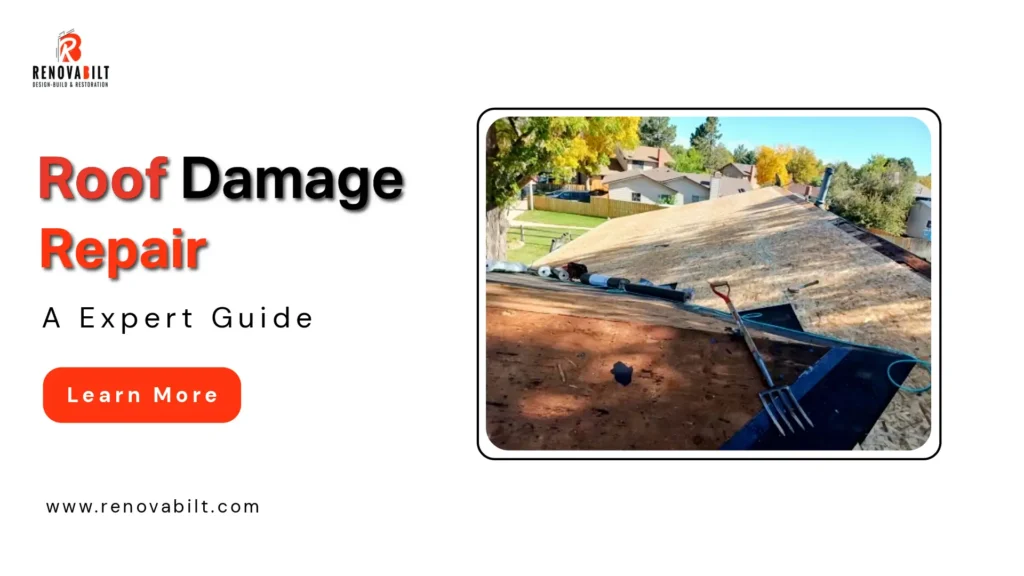
A roof is a lot more than the shingles and the plywood. It is like a system that quietly keeps your home and everything in it safe from the rain, the heat, and the bad weather. Because you do not see it, most people who own homes do not think about their roof until something bad happens, like a stain on the ceiling or water dripping in the living room. At that point, what could have been a fix becomes a big and expensive problem. This is why roof damage repair is so important and needs to be done on time.
If you fix problems with your roof early, you can stop big problems from happening and keep your home safe without any surprise stress or costs.
At RenovaBilt, we’ve spent over a decade on ladders and rafters. As IICRC-certified professionals with true 24/7 availability, we’ve seen how a small $200 repair can snowball into a $20,000 replacement simply because the early warning signs were missed.
In this Roof Damage 101 guide, we’ll break down everything you need to know about identifying roof problems early, assessing damage like a pro, and deciding when it’s time to repair or replace.
The True Cost of Neglect: Why Early Detection Matters
Before we dive into the “how,” let’s look at the “why.” According to industry data, the average asphalt shingle roof is designed to last 20 to 25 years. However, nearly 40% of roofs fail prematurely due to poor maintenance and unaddressed minor damage.
| Damage Type | Minor Repair Cost | Major Neglect Cost |
| Missing Shingle | $150 – $350 | $2,000+ (Structural Rot) |
| Clogged Gutters | $100 – $200 | $5,000+ (Foundation/Siding) |
| Small Leak | $400 – $800 | $15,000+ (Mold/Ceiling Collapse) |
By learning how to spot roof damage now, you aren’t just saving your roof, you’re saving your bank account.
The Anatomy of a Healthy Roof (And Where It Fails)
To understand how to spot roof damage, you first need to know what a healthy system looks like. Most homeowners think the shingles are the roof. In reality, the shingles are just the “skin.”
- The Decking (The Skeleton): The wooden boards that make up the frame.
- Underlayment (The Vital Organs): A water-resistant felt or synthetic layer.
- Flashing (The Joints): Metal pieces that seal “intersections” like chimneys.
- Shingles (The Armor): The outer layer that deflects UV rays and wind.
Data Point: According to the National Roofing Contractors Association (NRCA), over 75% of roof leaks originate at the flashing or penetration points (vents, pipes, chimneys), not through the shingles themselves.
Step 1: Interior Investigation (The Attic Audit)
You don’t always need a ladder to find a problem. In fact, some of the most telling signs of roof damage start inside the house.
Check for Light “Stars”
On a sunny day, head into your attic and turn off the lights. If you see pinpricks of daylight coming through the roof boards, you have holes. If light can get in, water can get in.
The Sag Test
Examine the rafters and the underside of the roof deck. Any sagging or “dipping” in the wood suggests long-term moisture exposure. Structural integrity is non-negotiable; if the decking is soft to the touch, the damage is likely advanced.
Moisture and Mold
Look for dark streaks, water spots, or “blossoms” of white or black mold. IICRC-certified experts (like our team at RenovaBilt) emphasize that mold in an attic is a primary indicator of poor ventilation or a persistent leak.
Step 2: Exterior Visual Inspection (From the Ground)
You can perform a significant portion of a roof damage assessment without ever leaving the ground. Use a pair of binoculars to get a closer look at these critical areas.
Identifying Shingle Issues
- Curling or Cupping: When shingles turn upward at the edges, they are no longer shedding water effectively. This is often a sign of extreme heat or an aging roof.
- Cracked Shingles: Wind stress or thermal expansion can cause shingles to crack. A single crack is a gateway for leaks.
- Bald Spots: Look for areas where the granules have worn off. This exposes the underlying asphalt to UV rays, causing it to become brittle and fail.
The “Granule Trap”
Check your downspouts and gutters. Are they filled with what looks like coarse black sand? Those are shingle granules. A small amount is normal for a new roof, but a heavy accumulation in an older roof means the “armor” is falling off.
Step 3: Assessing the “Soft Spots” and Flashings
Flashings are the unsung heroes of your roof. These are the metal thin pieces installed around chimneys, vents, and valleys to redirect water.
Chimney and Vent Seals
According to insurance industry statistics, 90% of roof leaks occur at the flashing. If the caulking is cracked or the metal is rusted/pitted, your roof is vulnerable.
The Valley Check
The valleys (where two roof slopes meet) are the highest-traffic areas for rainwater. If these are cluttered with debris or have missing shingles, you have a recipe for a major leak. This is a critical area when identifying roof problems early.
Step 4: Weather-Specific Damage (Hail and Wind)
In many parts of the US, storm damage is the leading cause of sudden roof failure.
Hail Damage
Hail doesn’t always leave a hole; it leaves a “bruise.” These look like small, dark indentations where the granules have been knocked away. Over time, the sun degrades these spots, leading to a leak months after the storm has passed.
Wind Uplift
High winds don’t just blow shingles off; they can “break the seal.” Shingles are held down by a strip of sealant. If wind lifts the shingle, it breaks that seal. Even if the shingle lies back down, it is no longer water-tight.
Step 5: The “Age vs. Condition” Calculus
One of the most common questions we get at RenovaBilt is: “How do I know if my roof needs replacing?”
Sometimes, the damage isn’t caused by a storm, but by time. Use the following criteria to evaluate your roof’s lifespan:
- The 20-Year Mark: If your asphalt roof is over 20 years old, it is statistically nearing the end of its functional life.
- Neighborhood Trends: Are your neighbors all getting new roofs? Homes in a subdivision are usually built at the same time and endure the same weather.
- Energy Bills: A sudden, unexplained spike in cooling or heating costs can indicate that your roof’s insulation or ventilation has been compromised by moisture.
Step 6: Professional Roof Damage Assessment
While DIY checks are great for catching obvious issues, a professional assessment is vital for insurance claims and long-term peace of mind.
At RenovaBilt, our 10+ years of experience allow us to see what the untrained eye misses. Our IICRC-certified technicians use moisture meters and thermal imaging to find “hidden” leaks behind walls before they cause structural rot.
What to Expect During a Professional Inspection:
- Core Sampling: Checking the layers of the roof.
- Structural Evaluation: Ensuring the load-bearing components are dry and sturdy.
- Gutter and Drainage Analysis: Ensuring water is moving away from your foundation, not just off your roof.
Step 7: The “Invisible” Threat – Attic Ventilation
One of the biggest “silent killers” of a roof isn’t rain; it’s heat from inside your house.
Why Ventilation Matters
In the summer, an unventilated attic can reach 150°F. This extreme heat literally “cooks” your shingles from the inside out, causing them to become brittle and lose their protective granules prematurely.
In the winter, poor ventilation leads to Ice Damming. When heat escapes from your living space into the attic, it melts the snow on the roof. That water runs down to the cold eaves and refreezes into a dam of ice. This ice pushes water up under your shingles and into your walls.
How to Check Your Ventilation:
- Touch the Ceiling: On a hot day, if your ceiling feels warm to the touch, your attic is trapping heat.
- Check the Vents: Look for soffit vents under your eaves. If they are painted over or clogged with bird nests, your roof cannot “breathe.”
Step 8: The Financial Side of Roof Damage Assessment
When you are asking, “How do I know if my roof needs replacing?” you aren’t just looking at shingles, you’re looking at your home’s equity.
Repair vs. Replacement: The 30% Rule
At RenovaBilt, we use a professional benchmark: If more than 30% of the roof surface is damaged or showing signs of advanced wear (bald spots, widespread curling), a full replacement is usually more cost-effective than piecemeal repairs.
| Scenario | Repair Logic | Replacement Logic |
| Wind Storm | 3-5 shingles blown off. | Entire slopes lifted or creased. |
| Leaking | Isolated to one vent pipe. | Multiple leaks across different rooms. |
| Age | 10 years old (Mid-life). | 20+ years old (End-of-life). |
Step 9: RenovaBilt’s 5-Point Prevention Plan
Prevention is the difference between a minor weekend fix and a $20,000 disaster. Here is our expert-recommended maintenance schedule:
1. The Bi-Annual Gutter Clean
Clogged gutters are the #1 cause of “fascia rot.” When water backs up, it sits against the wooden boards that hold your gutters. Within two seasons, that wood becomes soft, and the gutters can literally pull away from the house.
2. Tree Management
Overhanging branches are “highways” for squirrels and raccoons who can chew through vents. More importantly, branches rubbing against shingles act like sandpaper, stripping away granules during high winds. Keep branches at least 6 feet away from the roofline.
3. Moss and Algae Treatment
If you see green or black streaks, it’s not just “dirt.” It’s Gloeocapsa magma (cyanobacteria) or moss. Moss holds moisture against the shingles like a sponge, leading to rot. Never power wash your roof; it will blast the protective granules off. Use a professional chemical treatment instead.
4. Inspect After Every “Event”
Don’t wait for a leak. After any wind storm over 50 mph or a hail event, do a quick walk-around. Look for shingles in the yard or “bruises” on the roof.
5. Professional “Tune-Up”
Every 3-5 years, have a certified pro check the pipe boots and chimney flashing. These rubber and metal components often wear out faster than the shingles themselves.
Step 10: Navigating the Insurance Maze
Many homeowners don’t realize that roof damage assessment is a critical part of an insurance claim. If you have “Replacement Cost Value” (RCV) coverage, your insurance may pay for a brand-new roof if the damage is caused by an act of God (hail, wind, fallen trees).
RenovaBilt Tip: Documentation is everything. Keep a “Roof Log” containing:
- Photos of the roof before the storm.
- The date of the last professional inspection.
- Receipts for any minor repairs.
When an adjuster sees that you have maintained the roof, they are far more likely to approve a full replacement claim because they can see the damage wasn’t caused by neglect.
Why Professional Certification Matters (The IICRC Difference)

You wouldn’t want an uncertified electrician wiring your house; your roof deserves the same standard. As an IICRC-certified firm, RenovaBilt adheres to strict scientific standards for moisture removal and structural integrity.
When we perform a roof damage assessment, we aren’t just looking for holes. We are checking for:
- Hidden moisture in the insulation.
- The presence of mold spores.
- Airflow efficiency.
With true 24/7 availability, we understand that roof emergencies don’t happen between 9 and 5. If a tree falls on your home at 2:00 AM, we are the team that answers the call.
Summary Checklist: Signs of Roof Damage
| Sign | Severity | Recommended Action |
| Missing/Loose Shingles | High | Immediate Repair |
| Granules in Gutters | Medium | Schedule Inspection |
| Water Stains on Ceiling | Critical | Call 24/7 Professional |
| Rusted Flashing | Medium | Reseal or Replace |
| Sagging Roofline | Critical | Professional Structural Assessment |
Protecting Your Sanctuary
Your roof is a shield, but even shields need maintenance. By staying proactive and knowing how to spot roof damage, you can extend the life of your home and ensure your family stays dry and safe.
If you’ve noticed any of the signs mentioned above, or if a recent storm has you worried, don’t wait for the next raincloud.
A single cracked flashing or a “bruised” shingle is all it takes for water to compromise your home’s structure. If you’re unsure about the state of your roof, don’t leave it to chance. Put our 10+ years of hands-on experience to work for you. Reach out to RenovaBilt any time, day or night, for a precision inspection that leaves no shingle unturned.