
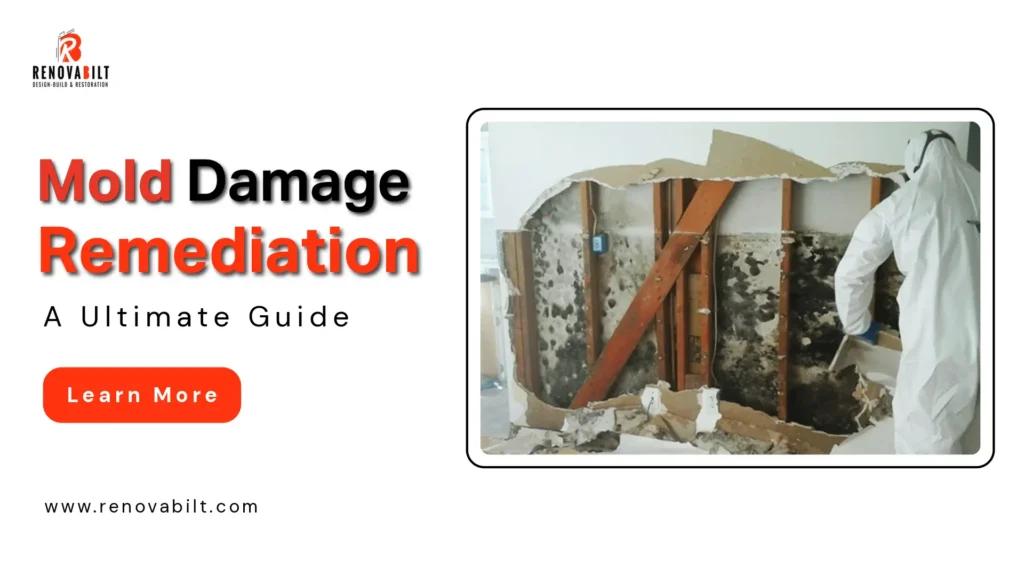
When you notice a pale green, soft layer on the drywall or detect an even “old basement” odor, the wall is already telling you that work must start. Mold rarely appears without a cause, and it often points to hidden moisture problems inside walls, ceilings, or flooring. At RenovaBilt, our IICRC-certified team understands how quickly these issues can escalate and why professional mold remediation is essential to restore a safe and healthy living environment.
This article does more than explain scrubbing steps – it shows the biology that decides whether a house remains sound. You will learn what mold remediation means, which events force you to request it, and which certified methods remove spores so that indoor air stays safe for the people who live there.
What is Mold Remediation? (It’s Not Just Cleaning)
To understand the solution, we have to define the process correctly. Many people use “mold removal” and “mold remediation” interchangeably, but they are different beasts.
What is mold remediation?
Technically, it is impossible to “remove” all mold from an indoor environment. Mold spores are microscopic and exist naturally almost everywhere, both indoors and outdoors. Mold remediation is the process of bringing mold levels back to a natural, “normal” state while addressing the moisture source that allowed the outbreak to happen in the first place.
The Data: Why You Should Care
- The 48-Hour Window: According to FEMA, mold can begin to grow on surfaces within 24 to 48 hours of water exposure.
- Allergy Impact: The Asthma and Allergy Foundation of America (AAFA) notes that mold is a primary trigger for allergic rhinitis and asthma, affecting millions of Americans.
- Economic Cost: Mold-related illnesses and damages cost the U.S. economy an estimated $22.4 billion annually in medical costs and lost productivity.
When is Mold Remediation Required?
Knowing when to call in the pros at RenovaBilt can save you thousands in structural repairs. Not every speck of mildew requires a full-scale intervention, but certain signs are non-negotiable.
- Visible Growth Over 10 Square Feet: The EPA suggests that if the moldy area is less than 10 square feet (roughly a 3×3 patch), you might handle it yourself. Anything larger requires professional containment.
- Persistent Musty Odors: If it smells like wet socks but looks clean, mold is likely hiding inside wall cavities or HVAC systems.
- Post-Flooding: If your home has experienced a pipe burst or storm surge, remediation is almost always necessary to prevent deep-seated rot.
- Health Symptoms: If family members experience unexplained sneezing, skin rashes, or respiratory issues that improve when they leave the house, the air quality is compromised.
The RenovaBilt Step-by-Step Mold Remediation Process
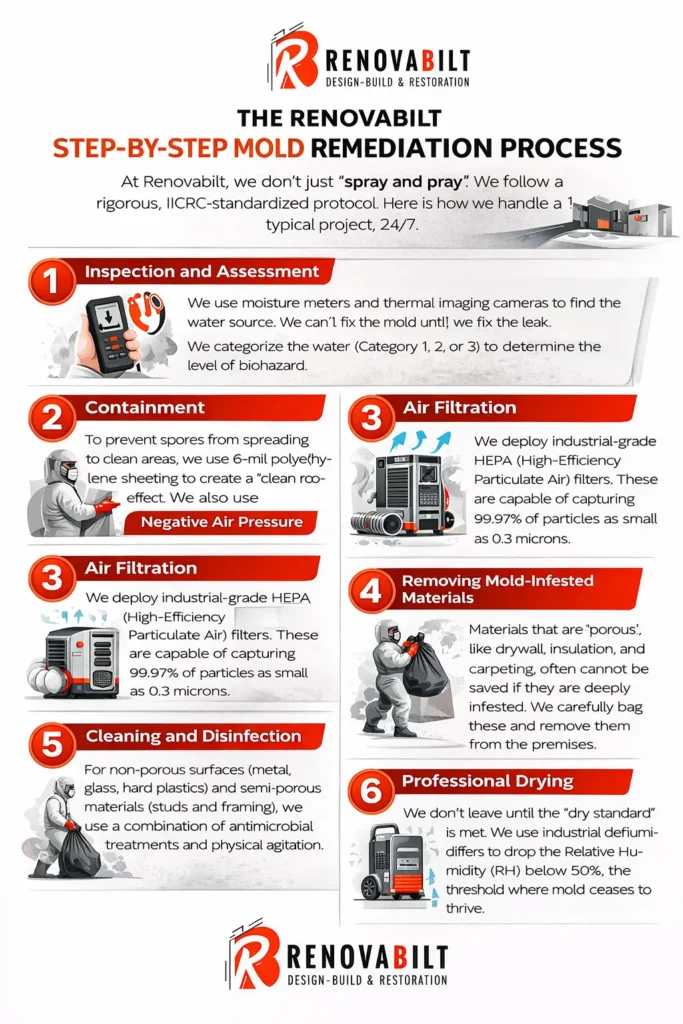
At RenovaBilt, we don’t just “spray and pray.” We follow a rigorous, IICRC-standardized protocol. Here is how we handle a typical project, 24/7.
Step 1: Inspection and Assessment
We use moisture meters and thermal imaging cameras to find the water source. We can’t fix the mold until we fix the leak. Then we categorize the water (Category 1, 2, or 3) to determine the level of biohazard.
Step 2: Containment
To prevent spores from spreading to clean areas, we use 6-mil polyethylene sheeting to create a “clean room” effect. We also use Negative Air Pressure. By using high-powered air scrubbers, we ensure that air only flows into the contaminated area, never out into the rest of your home.
Step 3: Air Filtration
We deploy industrial-grade HEPA (High-Efficiency Particulate Air) filters. These are capable of capturing 99.97% of particles as small as 0.3 microns.
Step 4: Removing Mold-Infested Materials
Materials that are “porous”, like drywall, insulation, and carpeting, often cannot be saved if they are deeply infested. We carefully bag these and remove them from the premises.
Step 5: Cleaning and Disinfection
For non-porous surfaces (metal, glass, hard plastics) and semi-porous materials (studs and framing), we use a combination of antimicrobial treatments and physical agitation.
Step 6: Professional Drying
We don’t leave until the “dry standard” is met. We use industrial dehumidifiers to drop the Relative Humidity (RH) below 50%, the threshold where mold ceases to thrive.
Advanced Mold Remediation Methods & Techniques
The industry has moved far beyond bleach and water. In fact, never use bleach on mold, as it’s 90% water and can actually feed the roots of mold on porous surfaces. Instead, we use these professional mold remediation techniques:
1. HEPA Vacuuming
This isn’t your household vacuum. It is a specialized tool used to “sandwich” the cleaning process, vacuuming before, during, and after treatment to ensure no loose spores remain on surfaces.
2. Media Blasting (Dry Ice or Soda)
For heavy infestations on wooden subfloors or attic rafters, we use dry ice blasting. This lifts the mold off the wood without damaging the structural integrity or introducing more moisture.
3. Antimicrobial Encapsulation
Once a surface is cleaned and dried, we may apply an “encapsulant.” Think of this as a specialized paint or sealer that prevents any remaining dormant spores from ever reactivating.
4. Fogging and Misting
For large-scale disinfection, we use ULV (Ultra-Low Volume) foggers to mist antimicrobial solutions into hard-to-reach areas like crawlspaces.
The Statistics of Hidden Danger
Many homeowners underestimate the resilience of mold. Let’s look at the numbers that define the industry:
| Factor | Statistic | Significance |
| Species Count | 100,000+ | Only a few hundred are common indoors, but many produce mycotoxins. |
| Spores per cubic meter | 1,000 – 10,000 | Normal outdoor levels; remediation aims to make indoor levels lower than outdoor. |
| Response Time | < 24 Hours | The “Golden Window” to prevent mold after a water event. |
| Property Value Hit | 10% – 25% | The potential decrease in home value if mold history isn’t professionally remediated. |
Why Professional Certification Matters
You might see “handymen” offering mold cleanup, but there is a reason RenovaBilt prioritizes IICRC Certification (Institute of Inspection, Cleaning and Restoration Certification).
Remediation is a science. Improperly handled mold can lead to cross-contamination, where spores are blown into the HVAC system and distributed throughout the entire house. A certified professional understands:
- Psychrometry: The study of air and water vapor.
- Microbiology: Understanding which species are toxic (like Stachybotrys chartarum, or “black mold”).
- Safety Protocols: Using PPE (Personal Protective Equipment) to ensure the technicians don’t bring the mold home with them.
Prevention – Keeping the Mold Away
Once RenovaBilt finishes the mould remediation process, the ball is in your court to keep the environment hostile to fungi.
- Monitor Humidity: Keep your home between 30% and 50%. Buy a cheap hygrometer from a hardware store to track this.
- Ventilation: Always run exhaust fans in bathrooms and kitchens. Ensure your dryer vents to the outside, not the attic.
- Inspect the Exterior: Check your gutters and downspouts. 90% of basement mold starts with poor drainage outside the foundation.
- Fix Leaks Fast: Even a slow “drip-drip” under a sink can create a microbial colony in a week.
Summary: Your Home, Restored
Mold is a natural part of our world, but it has no place inside your walls. From understanding what mold remediation is to implementing advanced mold remediation methods, the goal is always the same: a dry, breathable, and safe environment.
With over 10 years of experience, RenovaBilt stands ready to help you navigate the complexities of restoration. As a trusted provider of mold remediation services in Denver, we don’t just clean affected areas. We identify the source, remove contamination safely, and restore your property while giving you complete peace of mind.
Think you might have a mold problem? Don’t wait for the spores to spread. Schedule a free initial phone consultation to discuss your specific moisture concerns.