
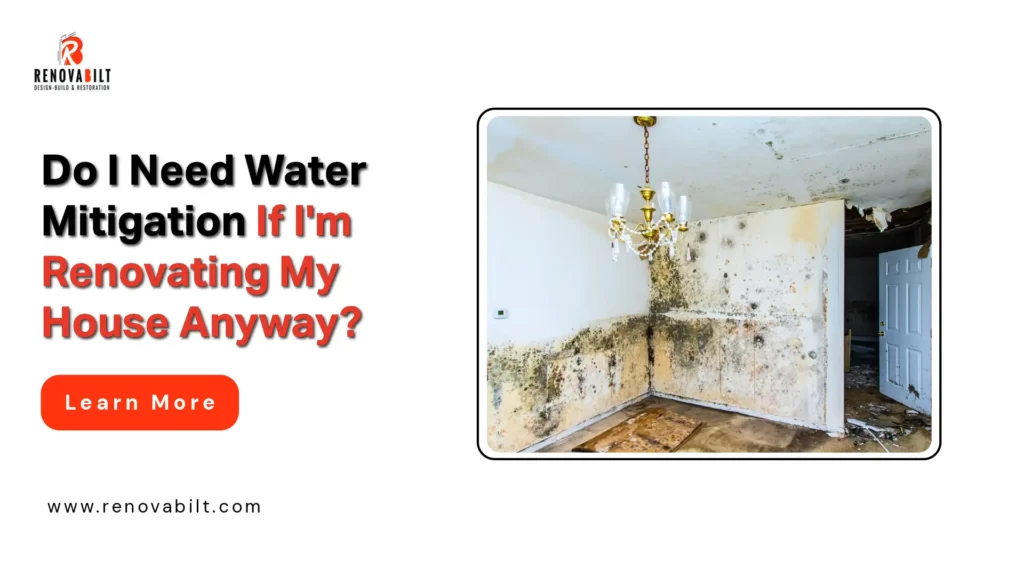
If you’ve discovered water damage in a room you already planned to remodel, you’re probably asking a reasonable question:
“Do I really need water mitigation, or should I just hire a contractor to start the renovation?”
It’s one of the most common calls we get at RenovaBilt. Maybe a pipe froze during a Colorado cold snap and burst behind your bathroom wall. Maybe spring snowmelt worked its way into your Aurora basement, or a slow leak under a kitchen cabinet finally became impossible to ignore. Since you were planning to replace that flooring or drywall anyway, skipping professional drying can feel like a logical shortcut.
The answer isn’t always as simple as choosing one or the other.
In many cases, water mitigation and renovation serve two different purposes. Understanding the difference can help you avoid hidden damage, mold growth, and unexpected repair costs while ensuring your renovation starts on a solid foundation.
Here’s how to think through it clearly.
Water Mitigation and Renovation Are Not the Same Thing
Many homeowners assume that a remodeling contractor and a water mitigation company perform the same work. While there may be some overlap, their goals are very different.
Water mitigation focuses on stopping additional damage.
This process is designed to stabilize your property after a water loss by:
- Removing standing water
- Drying structural materials
- Measuring moisture levels
- Preventing mold growth
- Removing materials that cannot be saved
- Preparing the property for repairs
Its purpose is to stabilize your property after a water loss before any rebuilding begins. That means removing standing water, drying structural materials with industrial air movers and dehumidifiers, mapping moisture levels throughout the affected area using professional meters and thermal imaging, removing materials that cannot be saved, and creating documentation for your insurance claim.
Renovation focuses on rebuilding and improving the space.
A remodeling contractor typically handles work such as:
- Installing new flooring
- Replacing drywall
- Painting
- Updating kitchens and bathrooms
- Rebuilding damaged areas
- Completing cosmetic improvements
Most contractors have neither the equipment nor the training to properly assess hidden moisture, and most renovations should begin after the structure has been professionally dried.
A Note on Denver Specifically
Denver’s dry reputation fools people. Because the air feels arid most of the year, homeowners assume water damage is something that happens elsewhere, in humid climates, near coastlines, in places that feel wet.
But Colorado’s freeze-thaw cycles are brutal on pipes. Temperatures can drop hard overnight and climb back above 50°F the next afternoon. Pipes in exterior walls, crawl spaces, and garages freeze, expand, and then thaw, sometimes cracking in the process without making a sound. By the time water shows up as a stain on a ceiling or a soft spot in a floor, it’s already been traveling through the structure for a while.
Spring snowmelt and summer thunderstorms add their own surprises. Denver’s clay-heavy soil doesn’t drain quickly, so water that has nowhere to go tends to find the path of least resistance, which is often a foundation wall.
None of this is a reason to panic. It’s just worth knowing that here, water damage tends to be less visible and more advanced by the time someone catches it.
The First Question to Ask Is: Is Anything Still Wet?
Whether you need professional mitigation depends less on your renovation plans and more on the current condition of your home.
Ask yourself:
- Is the source of the leak fully repaired?
- Has standing water been removed?
- Are the walls, insulation, or subfloor still wet to the touch, or potentially wet underneath the surface?
- Has the moisture spread into adjacent rooms or down into the subfloor?
- Has a professional tested the structure with moisture meters or thermal imaging?
That last point matters more than most homeowners realize. A surface that feels dry can still hold dangerous moisture content inside the material itself. The IICRC S500 standard — the industry benchmark for water damage restoration — defines acceptable dryness as moisture levels that match comparable unaffected materials in the same structure, generally targeting wood moisture content around 9% or below for typical indoor conditions. Structural wood above 20% moisture content is at risk of supporting mold growth. Without professional testing, there’s no reliable way to know which side of that line you’re on.
Covering damp framing or subfloors with new materials traps that moisture inside your home, and the problems that follow show up weeks or months later, well after your renovation is complete and your contractor has moved on.
When You May Still Need Water Mitigation
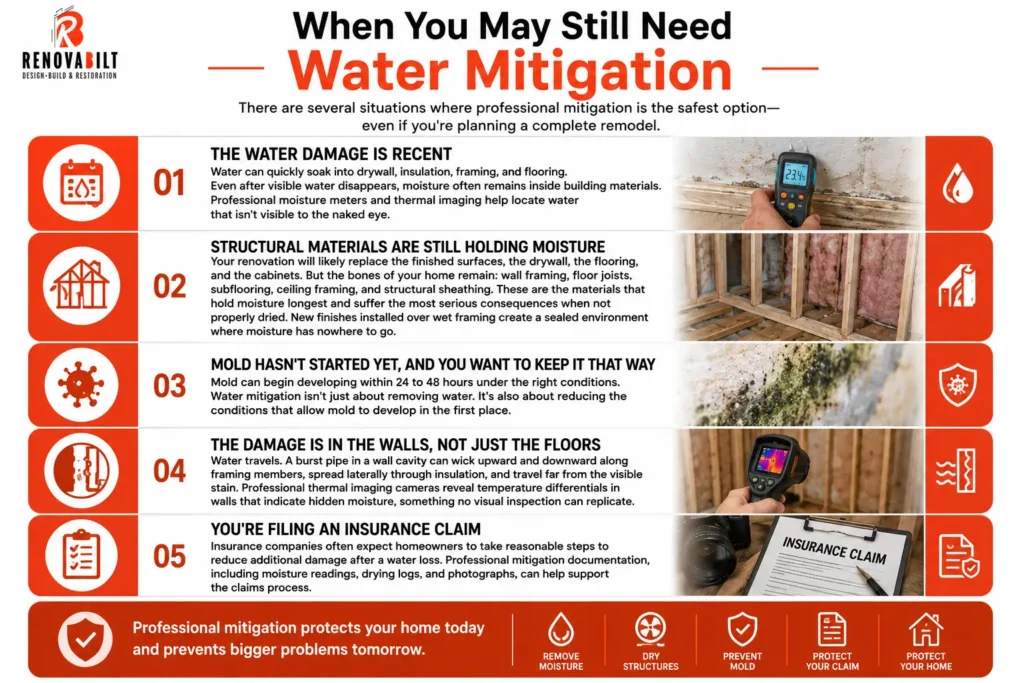
There are several situations where professional mitigation is the safest option—even if you’re planning a complete remodel.
The Water Damage Is Recent
Water can quickly soak into drywall, insulation, framing, and flooring.
Even after visible water disappears, moisture often remains inside building materials. Professional moisture meters and thermal imaging help locate water that isn’t visible to the naked eye.
Structural Materials Are Still Holding Moisture
Your renovation will likely replace the finished surfaces, the drywall, the flooring, and the cabinets. But the bones of your home remain: wall framing, floor joists, subflooring, ceiling framing, and structural sheathing. These are the materials that hold moisture longest and suffer the most serious consequences when not properly dried. New finishes installed over wet framing create a sealed environment where moisture has nowhere to go.
Mold Hasn’t Started Yet, And You Want to Keep It That Way
Mold can begin developing within 24 to 48 hours under the right conditions.
Water mitigation isn’t just about removing water. It’s also about reducing the conditions that allow mold to develop in the first place.
The Damage Is In The Walls, Not Just The Floors
Water travels. A burst pipe in a wall cavity can wick upward and downward along framing members, spread laterally through insulation, and travel far from the visible stain. Professional thermal imaging cameras reveal temperature differentials in walls that indicate hidden moisture, something no visual inspection can replicate.
You’re Filing an Insurance Claim
Insurance companies often expect homeowners to take reasonable steps to reduce additional damage after a water loss.
Professional mitigation documentation, including moisture readings, drying logs, and photographs, can help support the claims process.
When a Contractor May Be Enough
There are situations where hiring a contractor instead of a dedicated mitigation company may be appropriate.
For example:
- You’re completely demolishing the affected room.
- Damaged flooring and drywall will all be removed.
- The leak has already been repaired.
- The structure has fully dried.
- Moisture testing confirms framing and subfloors are dry.
- No hidden water remains.
- There are no signs of existing mold growth.
In these situations, the contractor may be able to complete demolition, verify everything is dry, and proceed with reconstruction.
However, this approach only works if the remaining structural materials are actually dry.
Skipping the drying process simply because you’re replacing finishes can create bigger problems later.
What Happens If You Skip Water Mitigation?
Here’s the financial reality. Professional water mitigation typically runs $3 to $7.50 per square foot, and most residential jobs are completed within 3 to 5 days. That’s a real cost, but it’s a predictable, bounded one.
Mold remediation after the fact is a different story. Removing mold that has established behind freshly installed walls or under new flooring costs an average of $1,200 to $3,800, and severe cases can exceed $10,000. That figure doesn’t include tearing out and replacing the new finishes that were just installed over the problem. When you add demolition, reconstruction, and the cost of mold remediation, a restoration project that could have been handled cleanly for a few thousand dollars can balloon to many times that amount.
Beyond cost, the health consequences of mold, respiratory irritation, allergic reactions, and air quality degradation affect the people living in the home while the problem develops silently behind the walls.
Why Water Damage Isn’t Always Visible
One of the biggest misconceptions about water damage is that everything affected is obvious.
In reality, water often travels far beyond the visible stain or puddle.
It can move through:
- Wall cavities
- Floor assemblies
- Under cabinets
- Beneath flooring
- Behind baseboards
- Into insulation
Professional restoration teams use pin and pinless moisture meters to measure material moisture content at depth, and infrared thermal cameras to identify temperature differentials behind surfaces that indicate hidden wet zones. Without these tools, you’re making renovation decisions based on incomplete information.
Can You Remove Water-Damaged Materials Yourself?
Some homeowners choose to handle demolition themselves, especially when replacing old flooring or outdated drywall.
This can reduce labor costs in certain situations.
However, before rebuilding, it’s important to ensure:
- The water source has been repaired.
- All wet materials have been removed.
- The structure has been thoroughly dried.
- Moisture levels are within acceptable limits.
- There are no signs of hidden mold.
If you’re unsure, a professional inspection can provide peace of mind before reconstruction begins.
How to Decide Between Water Mitigation and Renovation
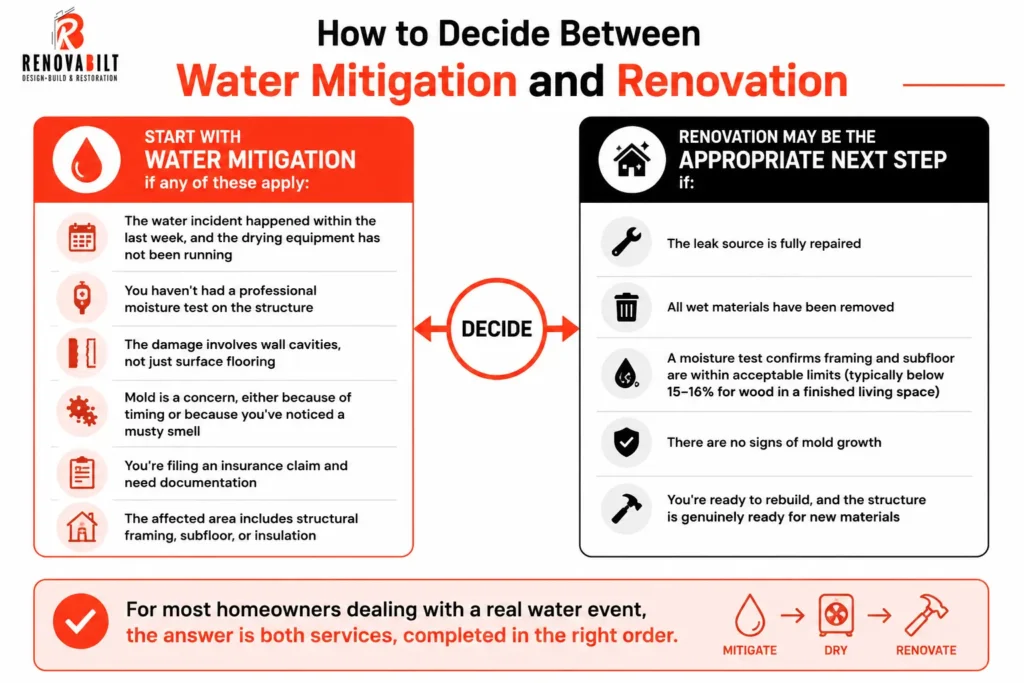
Start with water mitigation if any of these apply:
- The water incident happened within the last week, and the drying equipment has not been running
- You haven’t had a professional moisture test on the structure
- The damage involves wall cavities, not just surface flooring
- Mold is a concern, either because of timing or because you’ve noticed a musty smell
- You’re filing an insurance claim and need documentation
- The affected area includes structural framing, subfloor, or insulation
Renovation may be the appropriate next step if:
- The leak source is fully repaired
- All wet materials have been removed
- A moisture test confirms framing and subfloor are within acceptable limits (typically below 15–16% for wood in a finished living space)
- There are no signs of mold growth
- You’re ready to rebuild, and the structure is genuinely ready for new materials
For most homeowners dealing with a real water event, the answer is both services, completed in the right order.
Why Working With One Company Can Simplify the Process
Managing separate mitigation and renovation contractors after a water emergency adds coordination problems on top of an already stressful situation.
One company finishes drying. Another schedules an assessment. A third handles demolition. A fourth bids the rebuild. Every handoff creates opportunity for miscommunication, scheduling gaps, and accountability gaps. Who’s responsible when moisture readings weren’t documented properly before new flooring went in?
Working with a single team that handles both mitigation and reconstruction eliminates those friction points. The same people who assess and dry your home understand exactly what was found, what was dried, and what the structure looked like before new materials went in. There’s no information loss between phases, no finger-pointing between contractors, and no gaps in the project timeline.
Why Homeowners Across Denver and Aurora Choose RenovaBilt
At RenovaBilt, we understand that no two water losses are the same, and that the right advice depends on the actual condition of your home, not a one-size-fits-all recommendation.
We’ve worked in Denver and Aurora homes long enough to know how Colorado’s climate creates specific risks: freeze-thaw pipe bursts in Highlands Ranch crawl spaces, clay soil moisture intrusion in Aurora basements, appliance failures in older Capitol Hill kitchens. That local experience shapes how we assess damage and how we approach drying, including the fact that dehumidification equipment calibrated for Colorado’s altitude and variable humidity performs differently than it would at sea level.
When water mitigation is needed, we perform it using industry-standard equipment following IICRC S500 protocols, complete with moisture maps and drying logs that support your insurance claim. When your home is ready for reconstruction, our team transitions directly into the renovation phase without the delays that come from coordinating multiple contractors. From emergency drying through the final coat of paint, the project stays under one roof.
If you’re not sure whether your home needs professional mitigation before renovation begins, the safest first step is an honest assessment, not a guess.
Get a Free Quote
Not sure whether your home needs professional water mitigation before your renovation begins?
The team at RenovaBilt can assess the damage, determine whether hidden moisture is still present, and recommend the right solution based on your home’s condition—not a one-size-fits-all approach.
From emergency drying and structural moisture removal to complete reconstruction and remodeling, we provide comprehensive restoration services designed to help homeowners recover quickly and safely.
Contact RenovaBilt today to Get a Free Quote and learn how our experienced team can guide your project from water damage mitigation to a beautifully restored home.
Frequently Asked Questions
Only if the structural materials underneath, framing, subfloor, and joists have been professionally verified as dry. Replacing finished surfaces without drying the structure traps moisture and creates conditions for mold growth and wood rot that will appear after the renovation is complete.
Most residential mitigation projects take 3 to 5 days with professional drying equipment. Some situations involving hardwood, concrete, or large affected areas may take longer. The structure should reach acceptable moisture levels before any new materials are installed.
Standard Colorado homeowners’ insurance typically covers sudden and accidental water damage, burst pipes, appliance failures, roof damage from storms, including mitigation costs and reconstruction. Gradual leaks, deferred maintenance, and flood damage from external sources are generally excluded. Documenting mitigation professionally strengthens your claim.
Industry standards generally target wood moisture content below 15–16% for structural materials in a conditioned living space, with an IICRC goal of matching the moisture levels of similar unaffected materials in the same building. Your mitigation contractor should provide readings that confirm your specific structure has reached the appropriate drying standard.
Natural drying without equipment can leave significant moisture trapped in wall cavities, insulation, and structural materials, even when surfaces feel dry. A professional moisture assessment using meters and thermal imaging is the only reliable way to confirm the structure is truly ready for reconstruction.